
 By
By
Federal policy has been a primary constraint on the U.S. cannabis industry. On April 23, 2026, Acting Attorney General Todd Blanche signed a final order transferring FDA-approved cannabis products and cannabis produced under state medical licenses from Schedule I to Schedule III under the Controlled Substances Act (CSA).1 The order became effective upon publication in the Federal Register on April 28, 2026, following an executive order signed by Donald J. Trump on December 18, 2025 directing the process to move forward.2
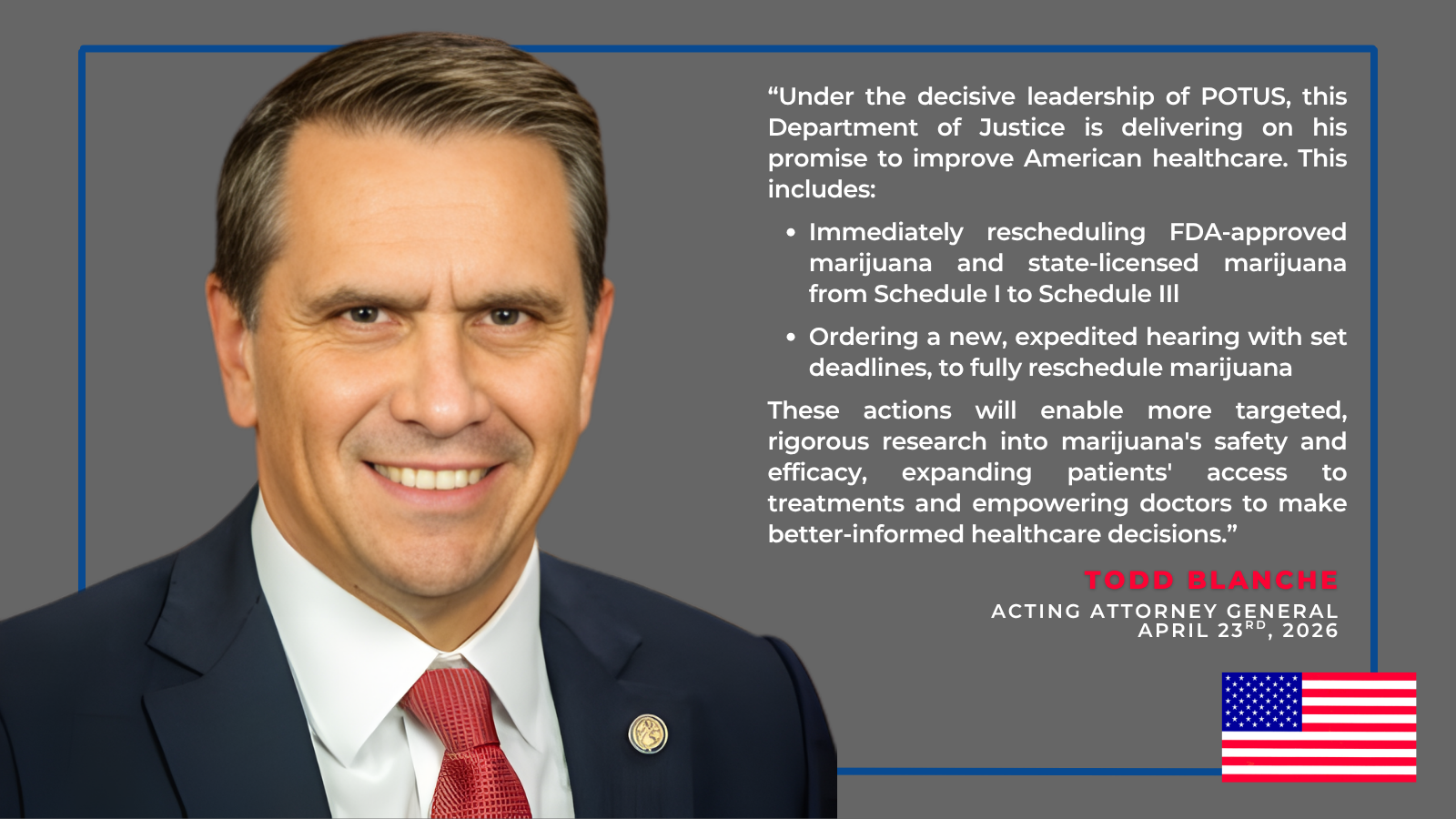
The scope of the order is limited. It applies to:
- FDA-approved drug products containing marijuana
- Cannabis produced and distributed under qualifying state medical programs
Adult-use cannabis, synthetic THC, and unlicensed cannabis remain classified as Schedule I.3
The change reflects a difference in how substances are defined under federal law.
Schedule I is reserved for substances with no accepted medical use and a high potential for abuse. Schedule III includes substances with accepted medical use and lower potential for dependence under regulated conditions. This order marks the first time the federal government has formally recognized marijuana as having accepted medical use under the CSA.4 Cannabis remains a controlled substance.
The order does not legalize cannabis. Activities outside the defined federal framework remain subject to enforcement. The change applies to how certain medical operations are treated under federal law, allowing for alignment with existing state programs in specific cases.
The process used to implement the order may be challenged. The DOJ relied on a treaty exception under Section 811(d)(1) of the CSA rather than the standard DEA rulemaking process. Smart Approaches to Marijuana has indicated it intends to challenge the approach under the Administrative Procedure Act. To protect against this, the order contains a built-in safeguard: if a court strikes down one part of it, the remaining portions automatically stay in effect rather than the entire order being thrown out5
Separately, the U.S. Department of Justice directed the Drug Enforcement Administration to reopen administrative proceedings to evaluate broader rescheduling, including adult-use cannabis. A hearing is scheduled to begin June 29, 2026 and conclude by July 15, 2026. New filings are required for participation, including for parties involved in prior proceedings.6
Market activity increased following the announcement, with higher trading volume and short-term volatility. The underlying business conditions did not change. The update reflects a shift in how a portion of the industry is treated under federal law.
Strategizing Exposure: Active Management in a Volatile Space
Given the complexities of state-versus-federal regulations and the volatility of the cannabis industry, active management is a critical tool for navigating this sector.
AdvisorShares provides three distinct pathways for professional portfolios:
-
Pure U.S. Exposure | AdvisorShares Pure US Cannabis ETF (MSOS): The largest U.S.-focused cannabis ETF, concentrated in top MSOs with scale and market share.
-
Global Diversification | AdvisorShares Pure Cannabis ETF (YOLO): Provides exposure to both U.S. and international cannabis markets.
-
Magnified Exposure | AdvisorShares MSOS Daily Leveraged ETF (MSOX): A daily leveraged ETF for sophisticated investors seeking to amplify exposure or overweight the theme with less cash.
Are Your Clients Positioned for the Rescheduling Shift?
As the federal landscape evolves, the gap between cannabis "potential" and "performance" is narrowing. Schedule time with us to learn how our actively managed strategies can fit into a diversified portfolio and what makes our approach to cannabis investing different.
|
NOTE ON RISK: Cannabis-related companies face unique risks, including regulatory shifts, agricultural dependencies, and intellectual property challenges. Leveraged products, like MSOX, carry high volatility risks and are intended for active daily monitoring.
————————————————————————————————————
— For Institutional Investor Use Only. Not for Public Distribution —
|
| Before investing you should carefully consider the Fund’s investment objectives, risks, charges and expenses. This and other information is in the prospectus and summary prospectus, a copy of which may be obtained by visiting the Fund’s website at www.AdvisorShares.com. Please read the prospectus carefully before you invest. Foreside Fund Services, LLC, distributor. An investment in the Funds is subject to risk, including the possible loss of principal amount invested. The risks associated with each Fund include the risks associated with the underlying ETFs, which can result in higher volatility, and are detailed in each Fund’s prospectus and on each Fund’s webpage. AIL-928878-2026-04-30 |
.png)

.png)