
 By
By
Until recently, psychedelic medicine had plenty of scientific momentum but very little regulatory visibility. That is starting to change as several late-stage programs move toward specific FDA milestones.
Compass Pathways is submitting a rolling New Drug Application it expects to complete in the fourth quarter.1 The FDA will hold a public hearing on the future therapeutic use of psychedelic drugs on September 14, and a resubmitted MDMA application is reportedly under review.2,3
None of those developments guarantees an approval, and none makes these treatments broadly available today. What has changed is the degree of visibility. The field is no longer waiting on an open-ended scientific or regulatory process. There are now identifiable products, late-stage trials, filings and agency decisions that can be followed on a calendar.
In 2025, 19.7 million U.S. adults (7.4%) had a past-year major depressive episode, and 13.8 million had one severe enough to cause serious impairment.¹ An estimated 18.2 million adults had a serious mental illness.¹ Among veterans, roughly 7 in 100 will have PTSD at some point in their lives, and of the 5.8 million veterans the VA served in fiscal 2024, 14% of men and 24% of women carried a PTSD diagnosis.² The late-stage psychedelic pipeline sits almost entirely in treatment-resistant depression, major depressive disorder, PTSD, and generalized anxiety disorder because that is where the unmet need is concentrated.
Federal Policy Begins to Define the Process
President Trump signed Executive Order 14401, Accelerating Medical Treatments for Serious Mental Illness, on April 18, 2026.³ Federal interest in psychedelic research is not new. Agencies including the Department of Veterans Affairs have supported research into psychedelic therapies for PTSD, depression, and other difficult-to-treat mental health conditions for several years.4
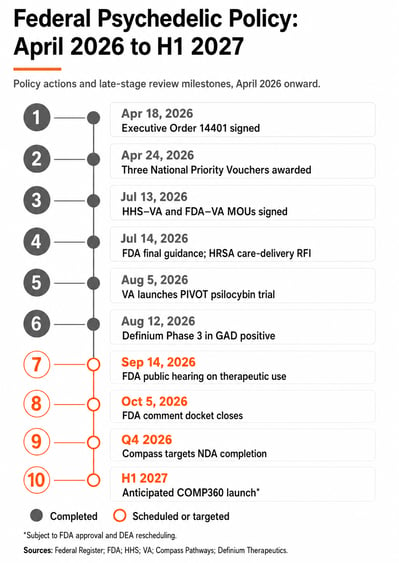
The order did not broadly reschedule psychedelic substances or make them legal for general medical use. Instead, it directed federal agencies to address several steps that could become relevant as individual products move through late-stage development and, potentially, FDA approval.4
Among its provisions, the order called for national priority vouchers for qualifying psychedelic therapies, expanded research coordination, greater involvement from the Department of Veterans Affairs, and expedited consideration of product-specific rescheduling following successful Phase 3 trials and FDA approval.4 Psilocybin, MDMA, LSD, and ibogaine remain Schedule I.
The sequence reflects the unusual regulatory structure surrounding psychedelic medicines. A successful clinical program can lead to an FDA application, but approval of a drug containing a Schedule I substance would still leave additional steps before commercial availability, including controlled-substance scheduling and the development of systems for administering the treatment. The executive order begins to place some of those steps within the same federal process.
The Regulatory Calendar Is Getting More Specific
Compass Pathways currently provides one of the clearest examples of how that process could unfold.
The company has reported positive results from two Phase 3 trials of COMP360 psilocybin in treatment-resistant depression. The FDA subsequently allowed Compass to use a rolling NDA submission, enabling portions of the application to be submitted as they are completed rather than waiting for the entire package to be filed at once.1
Compass expects to complete the submission during the fourth quarter of 2026. The company has also discussed a potential commercial launch in the first half of 2027, subject to FDA approval and the completion of required DEA rescheduling.5
Compass is furthest along among several psychedelic drug developers approaching later stages of clinical development. Other programs are advancing treatments for major depressive disorder, generalized anxiety disorder, PTSD, and related conditions using compounds that include psilocybin, MDMA, methylone, and other psychedelic or psychedelic-derived molecules.
Late-Stage Psychedelic Pipeline
| Sponsor | Compound | Lead indication | Stage | Administration Model | Next Catalyst |
| COMP360 (psilocybin) | Treatment Resistant Depression | Two positive Phase 3s; rolling NDA underway | One to two supervised dosing sessions | Final NDA submission targeted Q4 2026 | |
| Psilocybin | Major Depressive Disorder | Phase 3 | Single supervised dosing session | NDA anticipated' priority voucher held | |
| DT120 (lysergide ODT) | GAD; Major Depressive Disorder | Two positive Phase 3s | Single 100µg , supervised | Panorama GAD readout expected Sept. 2026 | |
| TSND-201 (methylone) | PTSD | Phase 3 (~300 patients) | Four once-weekly dosing sessions | Phase 3 enrollment | |
| MDMA-assisted therapy | PTSD | NDA reportedly resubmitted Aug. 2026* | Multiple sessions with therapeutic support | FDA response to resubmission | |
| BPL-003 (5-MeO-DMT) | Treatment Resistant Depression | Phase 3 activities initiated | In-clinic visit averaging ~2 house in Phase 2b | Merger vote Sept. 8, 2026 |
*Reported by Psychedelic Alpha based on sources familiar with the filing; not confirmed by the company. Programs differ in population, endpoint, comparator and supportive care, and results are not directly comparable. Sources: company disclosures; FDA; Psychedelic Alpha
The result is a pipeline with considerably more differentiation than the sector had only a few years ago. Programs now vary not only by compound and indication, but also by clinical stage, trial results, regulatory designation, balance-sheet position, and proximity to a potential submission.
What Do the FDA Priority Vouchers Change?
Shortly after the April executive order, the FDA awarded three Commissioner’s National Priority Vouchers to psychedelic drug programs. The recipients were subsequently identified as Compass Pathways, Usona Institute, and Transcend Therapeutics, covering programs studying psilocybin and methylone in depression and PTSD.5
The voucher program is designed to shorten FDA review for qualifying applications through earlier communication between sponsors and regulators and a more concentrated review process. Under the pilot program, reviews that would ordinarily take several months could potentially be completed on a substantially shorter timetable.
The vouchers do not alter the FDA’s standards for demonstrating safety, efficacy, or manufacturing quality.
For programs that are approaching an NDA, the effect is primarily on timing. A shorter review period can reduce the interval between submission and an agency decision, while the underlying clinical and regulatory requirements remain unchanged.
Capital Is Following Later-Stage Programs
Clinical progress has also been accompanied by a shift in financing activity across the sector.
Psychedelic companies raised more than $1 billion during the second quarter, with a large share of that capital concentrated among a relatively small number of companies.6 At the same time, pharmaceutical companies have continued to enter the space through acquisitions, partnerships, and licensing agreements.
The distribution of that capital is becoming increasingly uneven. Companies with pivotal data, later-stage programs, regulatory designations, or more clearly defined development paths have generally attracted more funding than businesses still operating primarily in early-stage research.
That divergence is also visible across the broader pipeline. Companies grouped under the same psychedelic-medicine theme can now be separated by several years of clinical development, regulatory progress, and capital requirements.
The VA Is Building Capacity, Not Just Running Trials
On August 5 the VA announced PIVOT, a randomized trial of psilocybin in veterans with treatment-resistant major depression, with or without concurrent PTSD. It will enroll roughly 240 veterans across five sites — Birmingham and Tuscaloosa, Portland, Philadelphia, and Puget Sound — and compares two psilocybin dose levels rather than psilocybin against placebo. The study runs through June 2031.¹⁰
The agency also disclosed that it is involved in 20 active clinical trials of psychedelic therapies, including an MDMA study announced in May enrolling about 80 veterans.¹⁰ On July 13, HHS and the VA signed a five-year memorandum of understanding covering clinical research, clinician training, real-world data collection, and the development of treatment protocols for future FDA-approved rapid-acting psychiatric products; the FDA and VA signed a separate complementary MOU the same day.¹¹ The VA is not only generating evidence. It is working out who administers these treatments, where, and with what supervision, while the drugs are still investigational.
Oregon provides a different example.
The state operates a regulated psilocybin-services program outside the FDA prescription-drug framework. Licensed service centers provide supervised psilocybin administration under Oregon’s state regulatory system, and beginning in 2025 those centers were required to report quarterly service data to Oregon Psilocybin Services.
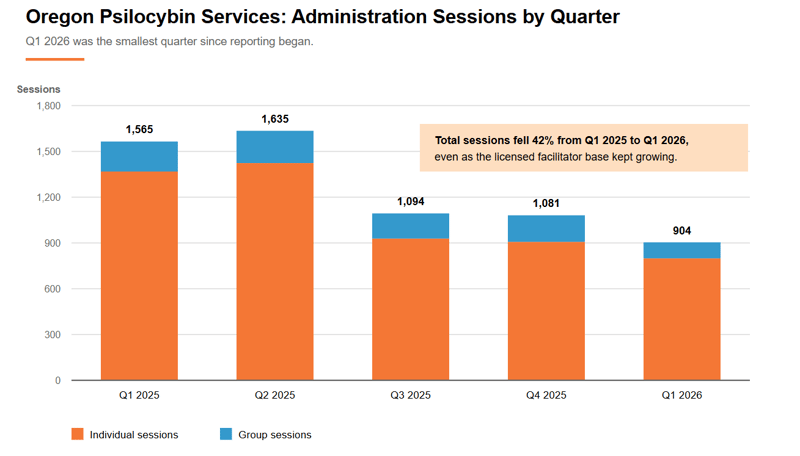
During 2025, Oregon reported 5,375 administration sessions serving 5,935 clients. Total administration sessions increased from 1,565 in the first quarter to 1,635 in the second quarter before declining to 1,094 in the third quarter and 1,081 in the fourth.8
 Source: Psychedelic Alpha, Oregon Psilocybin Services Tracker, drawing on Oregon Health Authority quarterly data. Accessed August 2026
The Oregon model is not directly comparable with a future FDA-approved medicine. Its facilitators, licensing requirements, payment structure, and legal framework differ from those that would apply to a prescription drug.
It does provide an early view of some of the logistics associated with supervised psychedelic administration. A session can require a licensed location, trained personnel, extended patient supervision, and follow-up procedures. Similar operational questions could arise if an FDA-approved psychedelic medicine carries requirements for supervised administration or restricted distribution.
Other jurisdictions are testing different structures. New Mexico's Medical Psilocybin Act creates a clinically framed program for qualifying conditions including treatment-resistant depression, PTSD, substance-use disorders, and end-of-life care, with the state targeting its first patients by the end of December 2026.¹³ Australia has permitted psychiatrist-supervised MDMA for PTSD and psilocybin for treatment-resistant depression since 2023, and its Department of Veterans' Affairs has committed to funding psychedelic-assisted psychotherapy for eligible veterans.¹⁴ Germany operates the European Union's first psilocybin compassionate-use program at two centers, in Berlin and Mannheim.¹⁵
The Gap Between Approval and Access
The development of psychedelic medicine now involves several timelines moving alongside one another.
Clinical trials determine whether individual therapies generate the data needed to support an application. NDA submissions and FDA reviews determine whether those products are approved. Controlled-substance scheduling can affect when an approved therapy becomes commercially available. Provider training, treatment facilities, reimbursement, and patient capacity can influence how it is ultimately delivered.
The FDA’s September 14 public hearing will bring several of those issues into the same discussion. The agency is seeking public input on the potential future therapeutic use of drug products containing psychedelic substances in “supervised and supportive settings.”2
For companies approaching regulatory decisions, the next twelve months contain several identifiable events: completed trial readouts, NDA submissions, potential FDA reviews, rescheduling decisions, and further development of the infrastructure surrounding treatment.
The uncertainty around individual outcomes remains. What has changed is the visibility of the process leading up to them.
Sources:
- Substance Abuse and Mental Health Services Administration. Release of the 2025 National Survey on Drug Use and Health. July 27, 2026.
- U.S. Department of Veterans Affairs, National Center for PTSD. How Common Is PTSD in Veterans? Accessed August 2026.
- Executive Order 14401, Accelerating Medical Treatments for Serious Mental Illness. April 18, 2026. 91 Fed. Reg. 21709 (April 22, 2026).
- Psychedelic Alpha. FDA Awards Priority Review Vouchers to Otsuka, Compass, and Usona. April 24, 2026.
- U.S. Food and Drug Administration. FDA Accelerates Action on Treatments for Serious Mental Illness Following Executive Order. April 24, 2026.
- Compass Pathways plc. Compass Pathways Announces Six-Month Data from Second Phase 3 Trial Confirming Rapid and Durable Profile. July 7, 2026; and Phase 3 COMP006 Part A results, February 17, 2026.
- Definium Therapeutics, Inc. Positive Topline Results from Phase 3 Voyage Study of DT120 ODT in Generalized Anxiety Disorder. August 12, 2026; and Phase 3 Emerge results in major depressive disorder, June 2026.
- Psychedelic Alpha. Two Years After Rejection, Resilient Quietly Refiles MDMA for PTSD Application. August 2026; Multidisciplinary Association for Psychedelic Studies, statement of August 10, 2026.
- Psychedelic Alpha. Otsuka to Acquire Methylone Drug Developer Transcend in $1.23B Deal. March 27, 2026.
- U.S. Department of Veterans Affairs. VA Launches Psilocybin Trial for Veterans With Treatment-Resistant Depression. August 5, 2026.
- U.S. Department of Health and Human Services. HHS & VA Announce Partnership to Advance Rapid-Acting Mental Health Treatments for Veterans. July 13, 2026.
- Psychedelic Alpha. Oregon Psilocybin Services Tracker. Accessed August 2026.
- New Mexico Department of Health. Medical Psilocybin Program Frequently Asked Questions. 2026.
- Psychedelic Alpha. Australia’s Psychedelic Experiment: Progress, Pitfalls, and What Comes Next. January 16, 2026.
- Psychedelic Alpha. Psilocybin Compassionate Use in Germany: The First Patients, Payers and Practicalities. June 16, 2026.
- U.S. Food and Drug Administration. Psychedelic Drugs: Considerations for Clinical Investigations. Final Guidance for Industry, July 2026. 91 Fed. Reg. 43101 (July 14, 2026).
- Health Resources and Services Administration. Request for Information: Training and Care Delivery Models for Safe Administration of Potential FDA-Approved Psychedelic Therapies in Ambulatory Clinical Settings. July 14, 2026.
|
— For Institutional Investor Use Only. Not for Public Distribution —
|
| Before investing you should carefully consider the Fund’s investment objectives, risks, charges and expenses. This and other information is in the prospectus and summary prospectus, a copy of which may be obtained by visiting the Fund’s website at www.AdvisorShares.com. Please read the prospectus carefully before you invest. Foreside Fund Services, LLC, distributor. An investment in the Funds is subject to risk, including the possible loss of principal amount invested. The risks associated with each Fund include the risks associated with the underlying ETFs, which can result in higher volatility, and are detailed in each Fund’s prospectus and on each Fund’s webpage. AIL-994702-2026-09-01 |

.jpg)
.png)