
 By
By
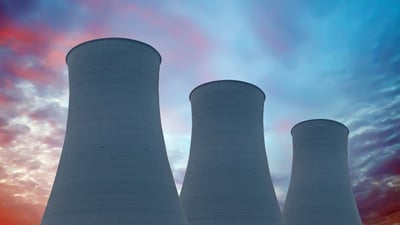 When we think about the infrastructure supporting the AI revolution, we often focus on the chips inside the servers. But behind those chips is a massive requirement for steady, unfailing power—not just to run the processors, but to keep them from overheating.
As data center energy demands skyrocket, a surprising veteran is returning to the center stage: Nuclear Power.
The Problem with "Intermittent" Cooling
Modern AI data centers are massive thermal engines. Because they generate heat 24/7, they require cooling systems that run 24/7. This creates a significant challenge for renewable energy sources like wind and solar. If the wind stops blowing or the sun goes down, the cooling system cannot simply "take a break."
If a cooling system loses power even for a moment, server temperatures can spike to dangerous levels in seconds, leading to hardware damage or a total system "thermal shutdown." To maintain the precise environment required for AI, data centers need "firm" power—energy that is steady, reliable, and available around the clock.
Nuclear: The Ultimate "Firm" Power Source
This is where nuclear energy comes in. Unlike intermittent renewables, nuclear power plants provide a constant "baseload" of electricity. This makes them the ideal partner for mission-critical HVAC systems.
Recent industry moves highlight this trend:
- Hyperscale Partnerships: We are seeing major cloud providers explore deals with nuclear plants to co-locate data centers directly at the power source.
- Small Modular Reactors (SMRs): The next generation of nuclear technology—SMRs—promises to provide localized, scalable power specifically designed to sit alongside large-scale data center campuses.
- Energy Reliability: Nuclear power offers one of the highest "capacity factors" of any energy source, meaning it is running at full power more than 90% of the time.
The Efficiency Flywheel
The partnership between nuclear and HVAC creates a powerful efficiency loop. High-capacity nuclear energy provides the steady electricity needed to run advanced, high-performance chillers and thermal management systems. In turn, these sophisticated HVAC systems allow data centers to operate at higher densities, maximizing the output of the AI hardware.
By removing the risk of power fluctuations, nuclear energy allows HVAC engineers to design more aggressive and efficient cooling profiles, ensuring that the invisible wall of heat never slows down the pace of innovation.
Investing in the Core of the Grid
The convergence of nuclear energy and advanced industrial cooling marks a new era in infrastructure. We are moving away from seeing HVAC as a building utility and toward seeing it as a critical component of the global energy and AI value chain. While HVAC companies aren't building nuclear reactors themselves, they are re-engineering their core business models to meet the unique demands of nuclear-powered AI data centers.
For investors, the opportunity lies in the companies that sit at this intersection—providing the industrial hardware that turns raw energy into the precise thermal environments required by the digital age.
|
Capture the growth of the infrastructure powering the future by investing in the AdvisorShares HVAC and Industrials ETF (ticker: HVAC).
|
|
— For Institutional Investor Use Only. Not for Public Distribution —
|
| Before investing you should carefully consider the Fund’s investment objectives, risks, charges and expenses. This and other information is in the prospectus and summary prospectus, a copy of which may be obtained by visiting the Fund’s website at www.AdvisorShares.com. Please read the prospectus carefully before you invest. Foreside Fund Services, LLC, distributor. An investment in the Funds is subject to risk, including the possible loss of principal amount invested. The risks associated with each Fund include the risks associated with the underlying ETFs, which can result in higher volatility, and are detailed in each Fund’s prospectus and on each Fund’s webpage. AIL-XXXX-XXXX |

.jpg)