By
Mention heating and air conditioning at a dinner party and you can watch the room's attention drift. HVAC conjures images of a rattling window unit, a furnace in the basement, or the service van that shows up when something breaks. Reliable, necessary, and, by reputation, a little dull.
That reputation undersells it. Few industries have stayed this essential for this long while changing this much. The basic job has not moved in a century: keep people, products and machines at the right temperature and humidity. Almost everything about how that job gets done has been reinvented, more than once.
For investors, that combination is worth a second look. Industries that last tend to share two traits: demand that does not go away, and the ability to adapt when technology, regulation or customers change. HVAC has a long record of both.
A 120-Year-Old Industry That Keeps Starting Over
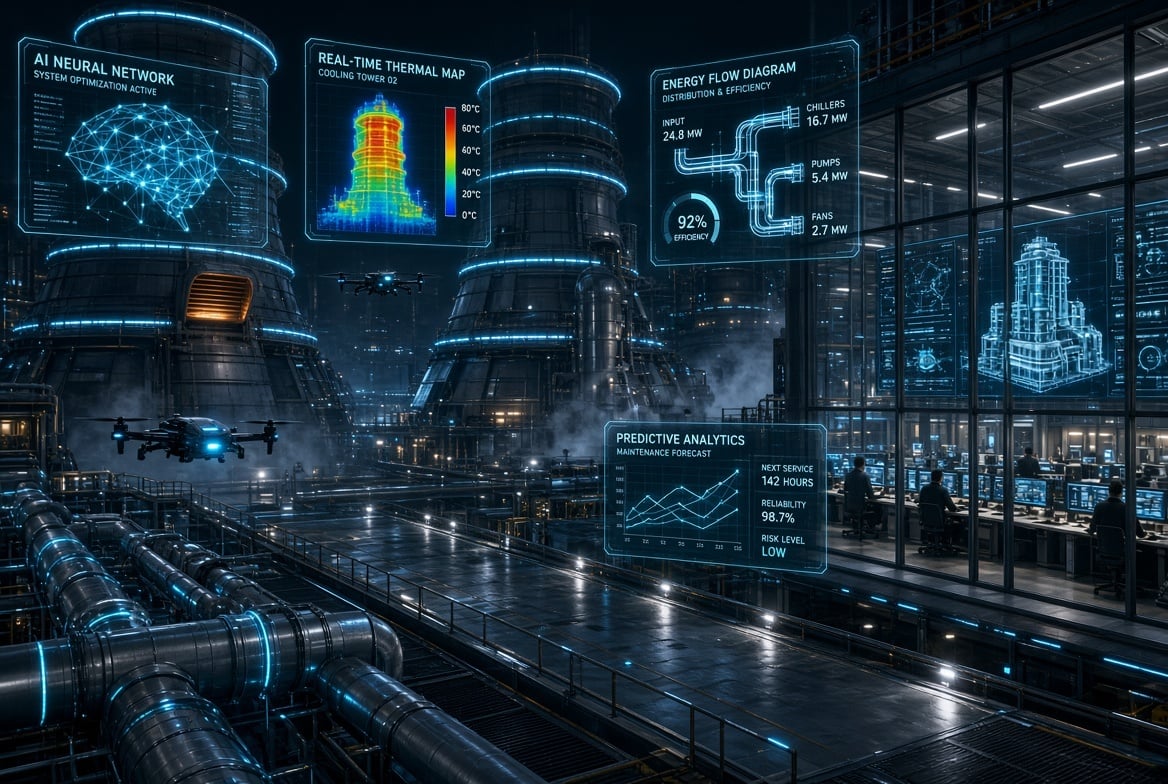
The computing requirements behind AI are significantly more energy intensive than those of the traditional digital economy. The International Energy Agency estimates that global data-center electricity consumption will roughly double from approximately 485 terawatt-hours in 2025 to 950 TWh by 2030, with electricity consumption from AI-focused data centers growing faster still, roughly tripling over that period.¹
That growth has consequences well beyond power generation. Nearly every watt consumed by computing equipment eventually becomes heat that must be removed from the facility, and as more computing power is concentrated into individual racks, cooling becomes a greater engineering challenge.
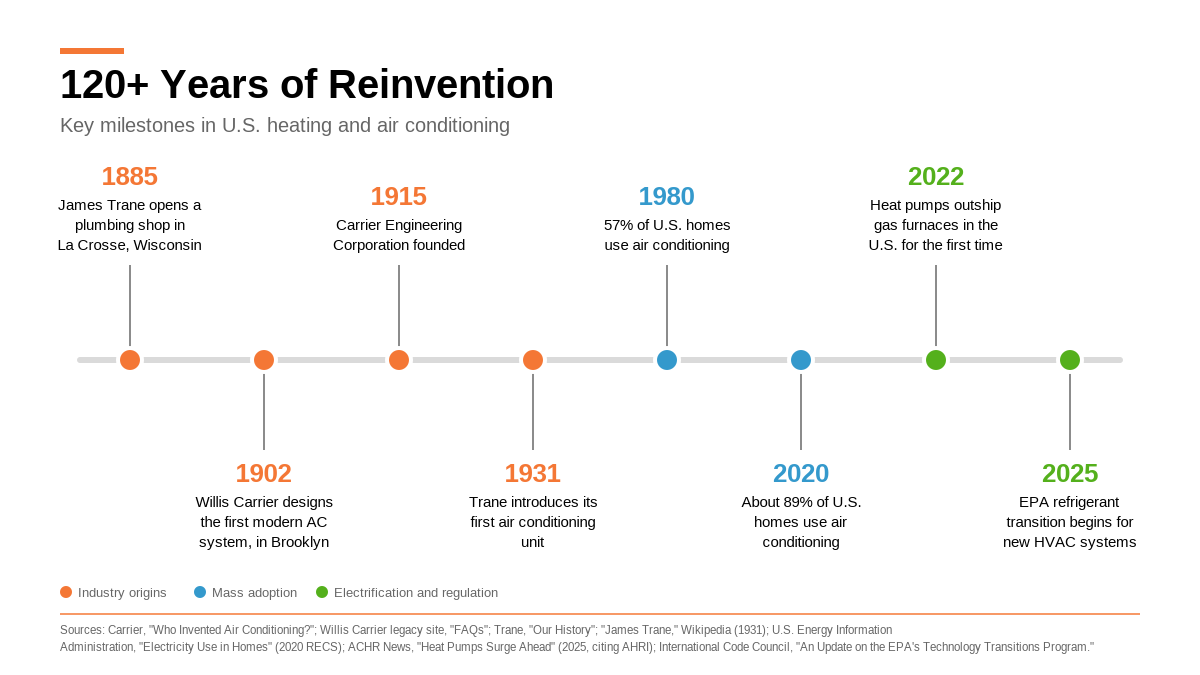
Modern air conditioning began as a manufacturing fix, not a comfort feature. In July 1902, a young engineer named Willis Carrier submitted drawings for a system to control humidity at the Sackett-Wilhelms printing plant in Brooklyn, where moisture was warping paper and throwing off multicolor print runs.¹ In 1915, he and six partners founded what became Carrier Engineering Corporation.²
Half a continent away, a Norwegian immigrant named James Trane had opened a plumbing and pipe-fitting shop in La Crosse, Wisconsin, in 1885. He and his son Reuben incorporated The Trane Company in 1913, left plumbing behind to manufacture heating equipment, and introduced the company's first air conditioning unit in 1931.³
More than a century later, both names are still on the equipment, and both are still on public companies. That kind of continuity is unusual. The industry did not survive by standing still; it survived because each generation of the business looked different from the one before it:
- Industrial Origins (1900s–1920s): humidity control for printing, textiles and manufacturing.
- Comfort Cooling (1920s–1950s): theaters, department stores and office towers, then homes.
- Mass Adoption (1960s–2000s): central air spreads through suburban housing and the U.S. Sun Belt grows around it.
- Efficiency and Regulation (1980s–today): successive refrigerant changes and tighter energy standards.
- Digital and Electrified (today): connected controls, heat pumps and data-center thermal management.
The Installed Base Is the Business
A trendy product has to win a new customer every year. HVAC equipment, once installed, creates years of follow-on demand: maintenance, repairs, parts, controls upgrades and, eventually, replacement.
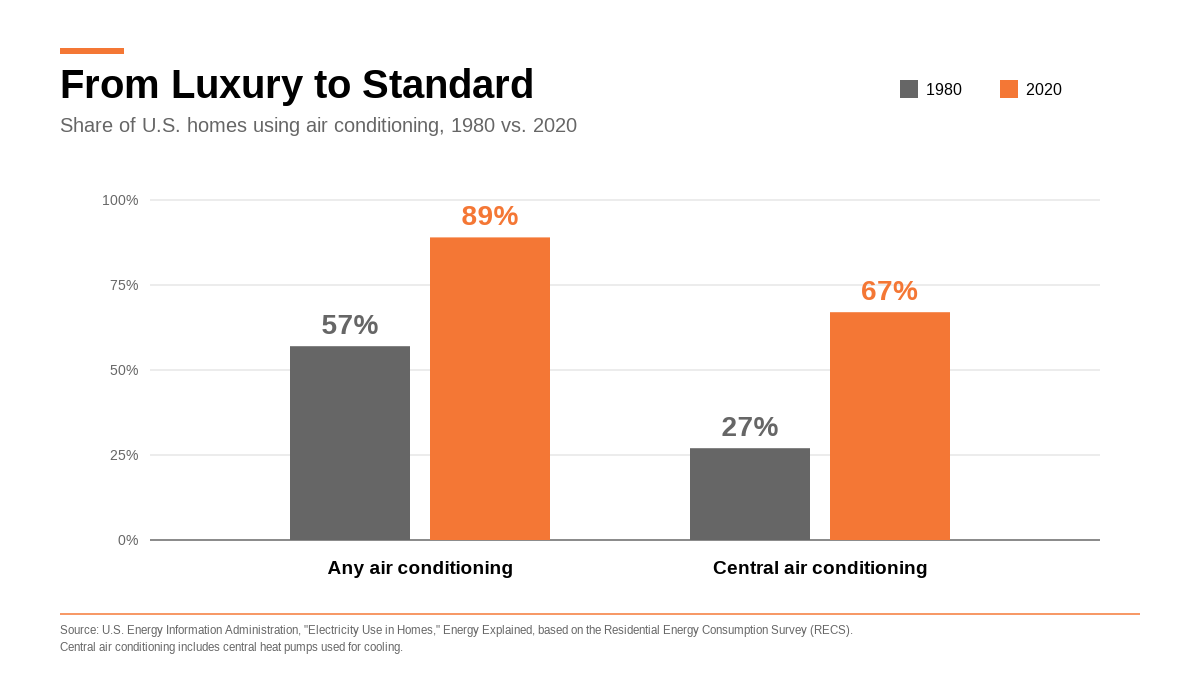
That installed base is enormous and still growing. According to the U.S. Energy Information Administration, about 89% of U.S. homes used air conditioning in 2020, up from 57% in 1980. Over the same period, the share of homes with central air rose from 27% to 67%.⁴ Across an estimated 123.5 million U.S. homes, that is a very large fleet of machines that will all need service and, eventually, a successor.⁵
As a result, much of the industry's volume today is tied to equipment that already exists rather than to new construction. One market-research estimate puts retrofit and replacement at roughly 62% of U.S. residential HVAC shipments in 2025.⁶ Replacement work does not depend on a housing boom. It depends on time, wear and the rising efficiency of what is available to replace older systems.
That does not make the business immune to cycles. Homeowners can delay a replacement, and commercial projects can be deferred. But the underlying need does not disappear; it accumulates.
Every Generation Rewrites the Rulebook
If the installed base supplies the steady demand, reinvention supplies the reasons to upgrade. HVAC has rarely gone a decade without a change that forced the industry to redesign its products.
Refrigerants. The chemistry inside cooling equipment has been overhauled repeatedly, from early ozone-depleting refrigerants to today's lower-global-warming-potential alternatives. The latest shift is under way now: under EPA's Technology Transitions rule, manufacturers of new residential and light-commercial systems had to move away from refrigerants with a global warming potential above 700 beginning in 2025, steering the market toward a new class of mildly flammable "A2L" refrigerants.⁷ That change touches equipment design, installation practices, technician training and building codes all at once.
Electrification. The heat pump, which moves heat rather than burning fuel to make it, has gone from niche to mainstream. Heat pumps first outshipped gas furnaces in the U.S. in 2022, and the lead held in 2025: about 3.64 million air-source heat pumps shipped versus 3.25 million gas furnaces, according to Air-Conditioning, Heating, and Refrigeration Institute (AHRI) data.⁸ ⁹
Intelligence. As we explored in When Old Tech Meets New, sensors, connected controls and analytics are turning mechanical systems into managed networks, and AI data centers are pushing cooling technology toward liquid and hybrid designs.
Each of these shifts can make existing equipment less efficient, more expensive to service or noncompliant with new standards. For the companies that design, distribute, install and maintain HVAC systems, change has historically been a source of demand rather than a threat to it.
Hard to Automate, Hard to Offshore
There is no software update that installs a rooftop unit or diagnoses a failing compressor in a hospital basement. HVAC work is physical, local and increasingly technical, and that makes skilled labor one of the industry's defining features.
The U.S. Bureau of Labor Statistics projects employment of HVAC mechanics and installers to grow 11% from 2025 to 2035, well above the 3% average for all occupations, with roughly 40,600 openings a year. BLS points to data-center and other commercial construction, more sophisticated climate-control systems, and ongoing retrofit and replacement work as drivers.¹⁰
That demand cuts both ways. A tight labor market can constrain how quickly projects get done and raise costs. It also tends to favor contractors and service providers with the scale, training programs and recurring maintenance relationships to keep technicians busy and customers loyal.
Most of the World Hasn't Bought Its First Air Conditioner
In the U.S., air conditioning is close to universal. Globally, it is not. The International Energy Agency's The Future of Cooling estimated about 1.6 billion air conditioners in use in 2016 and projected that number could reach 5.6 billion by 2050 in its baseline scenario. By then, the IEA estimates around two-thirds of the world's households could have one, with China, India and Indonesia accounting for half the total.¹¹
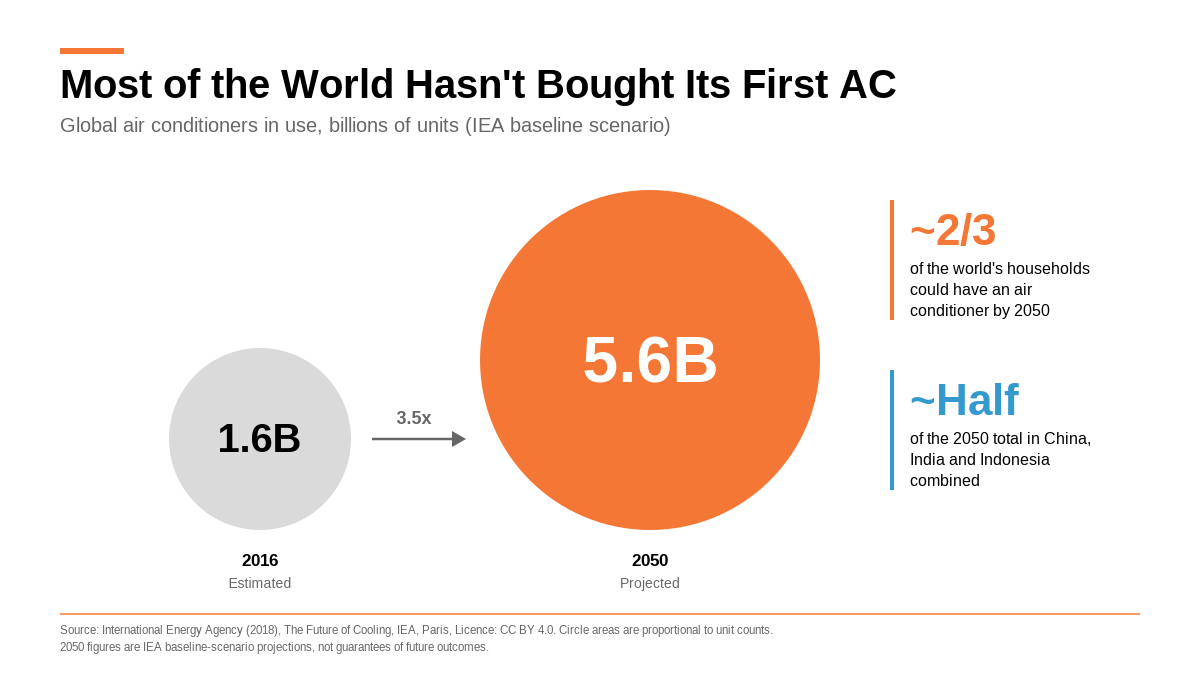
The IEA's same analysis frames cooling as one of the largest drivers of future electricity demand, which is why efficiency standards keep tightening. For the industry, that means growth in units and pressure to make each unit better, two forces that have shaped HVAC for most of its history.
Durable Doesn't Mean Smooth
Longevity is not the same as a straight line. HVAC demand moves with housing, interest rates, commercial construction and the weather. Regulatory transitions can pull purchases forward and leave a hangover: combined U.S. shipments of central air conditioners and heat pumps fell 20% in 2025 from 2024, as the market worked through the refrigerant changeover.⁸ Tariffs, input costs, labor shortages and shifting policy incentives can all affect margins and timing, and companies with similar exposure to the industry can produce very different results.
What a century-plus of history suggests is narrower but still meaningful: the need for heating, cooling and clean indoor air has outlasted every one of those cycles, and the industry has repeatedly found new ways to meet it.
Boring Is a Matter of Perspective
The AdvisorShares HVAC and Industrials ETF (HVAC) is built around that broader view of the industry. The actively managed fund invests across HVAC manufacturers and service providers, distributors, software and technology companies, energy-management firms and other industrial businesses serving residential, commercial and institutional markets.¹²
Some of those businesses are more than a century old. What they do next may look nothing like what they did first, which is exactly the point.
|
Explore an industry that has been reinventing itself for over a century with the AdvisorShares HVAC and Industrials ETF (ticker: HVAC).
|
|
— For Institutional Investor Use Only. Not for Public Distribution —
|
|
Before investing you should carefully consider the Fund’s investment objectives, risks, charges and expenses. This and other information is in the prospectus and summary prospectus, a copy of which may be obtained by visiting the Fund’s website at www.AdvisorShares.com. Please read the prospectus carefully before you invest. Foreside Fund Services, LLC, distributor. As of October 14, 2026, the AdvisorShares HVAC and Industrials ETF (HVAC) held Carrier Global Corp (CARR) at 4.12%, Trane Technologies PLC (TT) at 3.11%, and Vertiv Holdings Co. (VRT) at 3.90% of net assets. Holdings are subject to change and should not be considered a recommendation to buy or sell any security. Current holdings are available at HVAC.AdvisorShares.com Sources |