By
By
 Summer is here, and with it comes the familiar hum of air conditioners running around the clock. From the sweltering streets of Phoenix to heat-stricken Paris, the global demand for cooling has never been more urgent or more widespread.
In the U.S., staying cool isn't just about comfort; it's a necessity. Nearly 90% of households rely on air conditioning, making HVAC one of the most essential, and recession-resistant, industries in the country.1
As extreme heat becomes a global phenomenon, cooling demand is expanding well beyond American borders. This shift represents a compelling and durable investment opportunity — one that the AdvisorShares HVAC and Industrials ETF (NYSE Arca: HVAC) is uniquely positioned to capture.
Is Summer the Most Predictable Trade in Industrials?
Last summer, an intense heat wave from June 22–25, 2025 brought record-breaking temperatures that strained energy grids across the country and caused heating, ventilation, and air conditioning (HVAC) service demand to spike sharply.2 Interestingly, states that rarely see extreme heat — including Maine, Alaska, and Iowa — recorded some of the largest year-over-year surges in HVAC service activity.2
Consider the sheer scale of these climate events:
-
Massive Exposure: During that late June 2025 heat event, roughly 127 million Americans were under National Weather Service heat advisories.3
-
Grid Strain: The nation’s largest power grid operator, PJM Interconnection, recorded its highest electricity demand since 2011.3
-
Immediate Action: When temperatures skyrocket, businesses and homeowners don't debate whether to call an HVAC.
This has become a highly predictable pattern. In 2024 and 2025, extreme heat events across the United States caused air conditioning use to account for the entire year-on-year increase in electricity demand during the affected months.4 Summer heat has solidified its status as one of the most reliable and repeatable demand drivers in any industry.
What Happens When a Continent Discovers Air Conditioning?
While the U.S. HVAC market is mature and deeply embedded in daily life, Europe represents a massive, underpenetrated market in the early stages of a structural shift to HVAC solutions. Today, air conditioning is present in only about 20% of Europe's buildings, compared to 76% of households in North America.5 That gap is narrowing at an accelerated pace.
Between 2010 and 2019, the share of European households with air conditioning grew from 14% to 20%, and the trend has only accelerated since.6 Residential inquiries at one major UK air conditioning provider more than tripled over the last five years, with the 2025 summer heat wave sending demand soring.7 Looking further ahead, the International Energy Agency projects that the number of AC units in the EU will rise to 275 million by 2050 — more than double the 2019 figure.7
The urgency became incredibly vivid during the summer of 2025. An intense heat dome spread across the continent in August, pushing temperatures past 104°F in France and Spain.5 Earlier in the year, during the June and July 2025 heat wave, electricity demand in some parts of Europe spiked by as much as 14%, peaking above typical winter levels and contributing to outages in Italy.8 In Germany, energy demand during heat waves has risen more than fivefold since 1979.8
Over the past decade, global energy use for building cooling has grown more than twice as fast as total building energy use overall.6 For HVAC companies with global exposure, Europe represents a decades-long demand wave just heating up, not just a seasonal opportunity.
Why Does HVAC Keep Growing Regardless of the Season?
The seasonal surge is just one part of the story. The HVAC industry is experiencing a long-term structural expansion that goes well beyond any single summer.
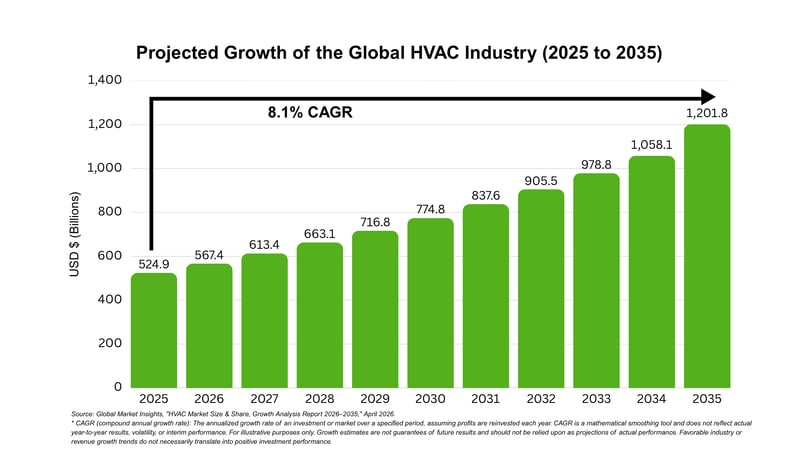
The global HVAC systems market — valued at approximately $524.9 billion USD in 2025 — is projected to grow at a compound annual growth rate (CAGR) of 8.1%, reaching an estimated $1.2 trillion USD by 2035.9,10 In the United States specifically, the market is valued at $156.9 billion USD in 2025 and is estimated to grow at a CAGR of 10.2% through 2035.10
This durable, multi-decade growth is driven by several converging forces:
- New Construction and Urbanization: Data centers, hospitals, commercial real estate, and residential housing all require highly sophisticated HVAC systems from day one.10
- System Replacements and Retrofits: The retrofit and replacement segment represented 46.2% of the U.S. HVAC market share in 2025, driven by aging infrastructure across America's building stock requires constant upgrading.11
- Smart technology adoption: IoT-enabled systems (the network of connected sensors, smart thermostats, and automated controls that communicate with each other over the internet), AI-powered predictive maintenance, and intelligent climate controls are reshaping the industry, and creating premium upgrade cycles.9
- Energy Efficiency Standards: Regulatory updates, including new refrigerant requirements that took effect January 1, 2025, are accelerating the replacement of older, less efficient equipment with modern systems.12
U.S. consumers spend over $10 billion USD annually on HVAC repair and maintenance services alone.1
Can a Niche Industrials ETF Outperform the Market?
The AdvisorShares HVAC and Industrials ETF launched on February 3, 2025, and quickly demonstrated the sector's potential.
In Q2 2025, the height of the summer heat season, the fund rose 25.82% Net Asset Value (NAV) | 25.77% (Market). This significantly outperformed the S&P 500 Index, which gained 10.94% over the same period. Demand that quarter was fueled by a powerful mix of domestic heat waves, infrastructure expansion, and advancing technologies.13
.png?width=800&height=450&name=HVAC%20Growth%20of%20$10%2c000%20(1).png)
As an actively managed fund, HVAC (the ETF) seeks long-term capital appreciation by investing in U.S. exchange-traded equity securities of companies across the HVAC and industrials landscape.14 Active management allows the portfolio to dynamically pivot towards the highest-conviction opportunities within the space as macroeconomics and environmental conditions evolve.
From Smart Thermostats to Data Centers — What's Next?
A wave of innovation is actively transforming the HVAC space, expanding the addressable market and improving the economics of every installation.
Geothermal heat pumps, still only about 1% of the U.S. market today, are gaining momentum as tax incentives make them more accessible to homeowners and businesses.15 Artificial intelligence integration is predicted to reduce service calls by 30% on a long-term basis, improving margins for HVAC companies while making systems more reliable for end users.16 Concurrently, smart thermostats, which allow zone-by-zone temperature control, are rapidly becoming a baseline consumer expectation.15
Meanwhile, the data center boom is creating an entirely new, fast-growing category of institutional HVAC demand. Traditional air conditioning units are often insufficient for modern high-density server environments, driving adoption of advanced cooling technologies that command higher price points and require specialized technician expertise.11
What Does All of This Mean for Investors?
The bottom line: the combination of near-universal household penetration, a massive legacy installed base requiring ongoing maintenance and replacement, surging institutional demand from data centers and commercial construction, and a wave of technology-driven upgrades makes HVAC potentially one of the most compelling long-term thematic investing opportunities available to today.
The AdvisorShares HVAC and Industrials ETF offers investors a targeted, actively managed way to access this growth — from the companies keeping America cool this summer to the innovators building the smart buildings of tomorrow.
|
Capitalize on this thematic opportunity by investing in the
|
|
* CAGR (compound annual growth rate): The annualized growth rate of an investment or market over a specified period, assuming profits are reinvested each year.
Sources:
1. ServiceTitan, "HVAC Statistics: The Data You Need to Know for 2026," February 12, 2026.
2. Samsara, "The Real Peak Season for HVAC? It's Not When You Think," August 6, 2025. 3. PBS NewsHour, "Eastern U.S. Sees One More Sizzling Hot Day Before Temperatures Are Set to Plunge," June 25, 2025. 4. OilPrice.com, "Heatwaves Are Driving a Worldwide Surge in Air Conditioning," June 2026. 5. World Resources Institute, "Europe's Soaring Heat and the Great Air Conditioning Dilemma," August 20, 2025. 6. PreventionWeb, "Europe's Soaring Heat and the Great Air Conditioning Dilemma," August 22, 2025. 7. CNN, "European Summers Are Getting Brutally Hot. So Why Is Air Conditioning So Rare?" July 2, 2025. 8. International Institute of Refrigeration (IIR), "Europe 2025 Heatwaves: Demand for AC Surges as Heat-Related Deaths Triple," September 2025. 9. AdvisorShares, "HVAC: 3rd Quarter 2025 Portfolio Review," September 30, 2025. 10. Global Market Insights, "HVAC Market Size & Share, Growth Analysis Report 2026–2035," April 2026. 11. MarketDataForecast, "U.S. HVAC Market Size, Share, Trends & Growth, 2034." 12. Cielo WiGle, "HVAC Industry Trends to Watch Out for in 2026," January 21, 2026. 13. AdvisorShares, "HVAC: 2nd Quarter 2025 Portfolio Review," June 30, 2025. 14. SEC EDGAR, AdvisorShares HVAC and Industrials ETF Summary Prospectus, January 22, 2025. 15. ServiceTitan, "12 HVAC Market Trends Expected to Heat Up in 2026," December 30, 2025. 16. The Chill Brothers, "Future of US HVAC: Revenue, Market Size & Job Outlook 2030," February 13, 2026. — For Institutional Investor Use Only. Not for Public Distribution —
|
| Before investing you should carefully consider the Fund’s investment objectives, risks, charges and expenses. This and other information is in the prospectus and summary prospectus, a copy of which may be obtained by visiting the Fund’s website at www.AdvisorShares.com. Please read the prospectus carefully before you invest. Foreside Fund Services, LLC, distributor. An investment in the Funds is subject to risk, including the possible loss of principal amount invested. The risks associated with each Fund include the risks associated with the underlying ETFs, which can result in higher volatility, and are detailed in each Fund’s prospectus and on each Fund’s webpage. AIL-953090-2026-06-16 |
.jpg)